

Who doesn’t love a good story? Because stories work on both a logical and an emotional level, there’s no better way to engage an audience.
When it comes to books, plays, movies, or TV shows, this is obvious. But I think some kind of narrative structure is important to almost anything that involves an audience: speeches, concerts, comedy routines, athletic performances, and even museums.
Everything is more gripping when it has some kind of “build” and a satisfying resolution.
I think the importance of narrative even applies to amusement park rides. A great roller coaster is a cohesive experience, with unexpected twists and turns — literally.
I recently experienced what I think is the best amusement park ride of all time: Journey to the Center of the Earth, the flagship ride at DisneySea, one of two Disney parks in Tokyo, Japan, (and, incidentally, the greatest overall theme park I’ve ever visited).
Like all good stories, Journey to the Center of the Earth begins with great world-building — and in this case, they’ve literally built the world of the story.
It’s called Mysterious Island, and it’s one of the eight “themed” areas of the DisneySea park. It’s a glorious steampunk environment based on the works of Jules Verne, the 19th-century French author of the novels Journey to the Center of the Earth, Mysterious Island, and 20,000 Leagues Under the Sea — and it even includes an “active” volcano that looms above the area, steaming and occasionally belching flames.
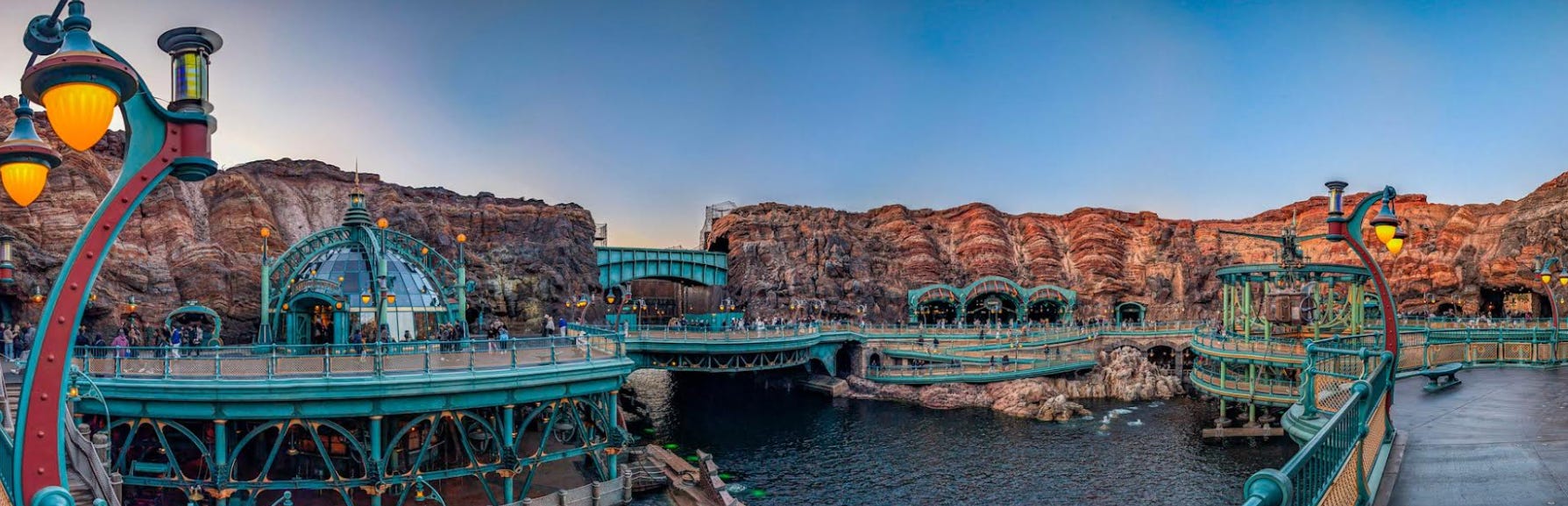
To ride Journey to the Center of the Earth, you enter the volcano and wind your way through a series of exhibits, setting the stage for the adventure to come.
On one hand, exhibits like this usually indicate that the theme park expects long lines (and this ride definitely has them — often lasting many hours, although you can pay to bypass them).
On the other hand, these particular exhibits are extraordinarily well done and really serve as a kind of Act One for the whole ride experience.
Captain Nemo and his fellow scientists have created something called “terravators” — or elevators — which can carry people deep into the subterranean world of the novel Journey to the Center of the Earth.
There’s also some nice foreshadowing: journal entries indicating that scientists have discovered the fossilized eggs of a massive, unknown arthropod.
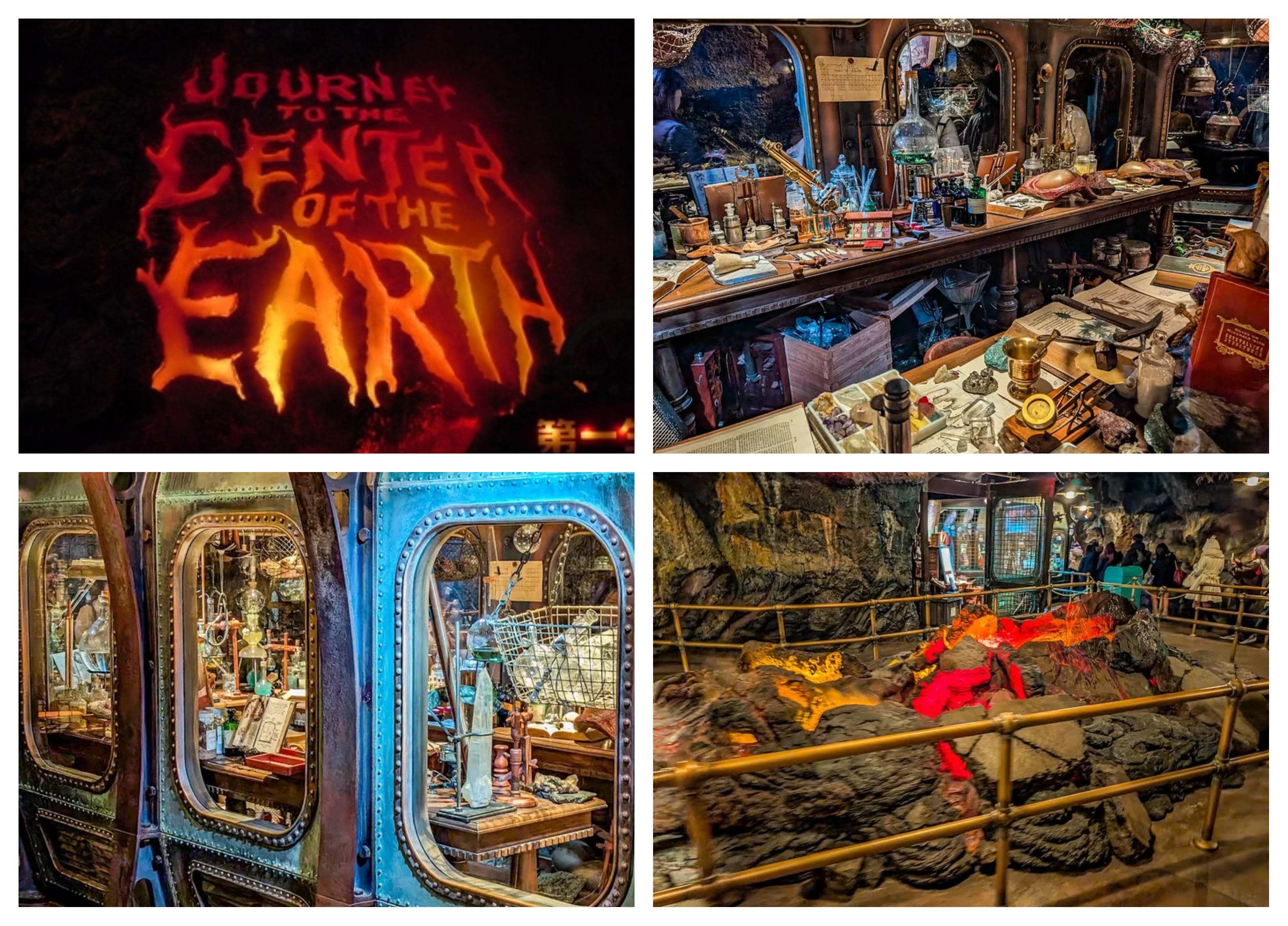
Next, you ride one of these terravators down to the subterranean research area, where a great tunnel has already been bored even deeper into the earth.
And the tension keeps building with more foreshadowing: warnings of increased seismic activity in the area. Worse, the scientist overseeing the operation is currently away on a break.
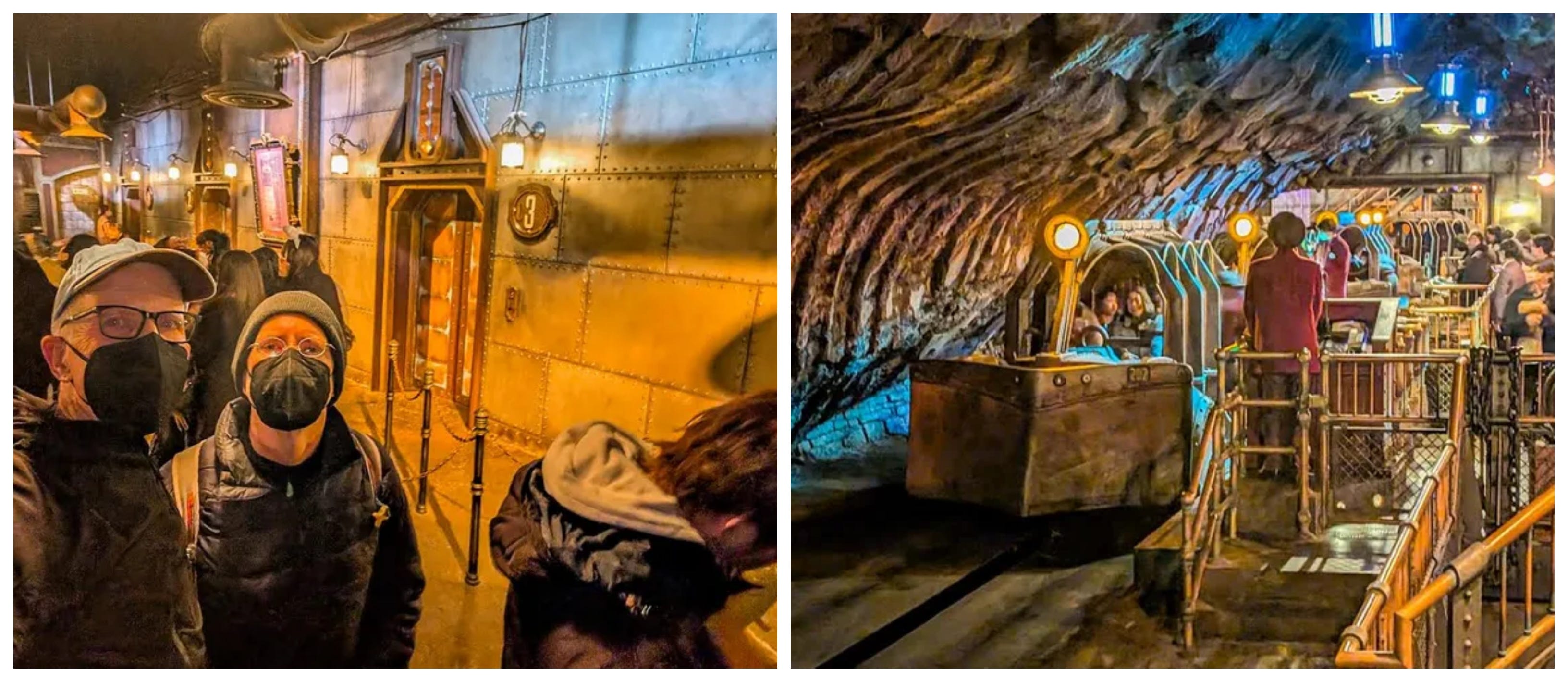
You climb aboard a steam-powered mining vehicle and Act Two begins: you head down deeper still.
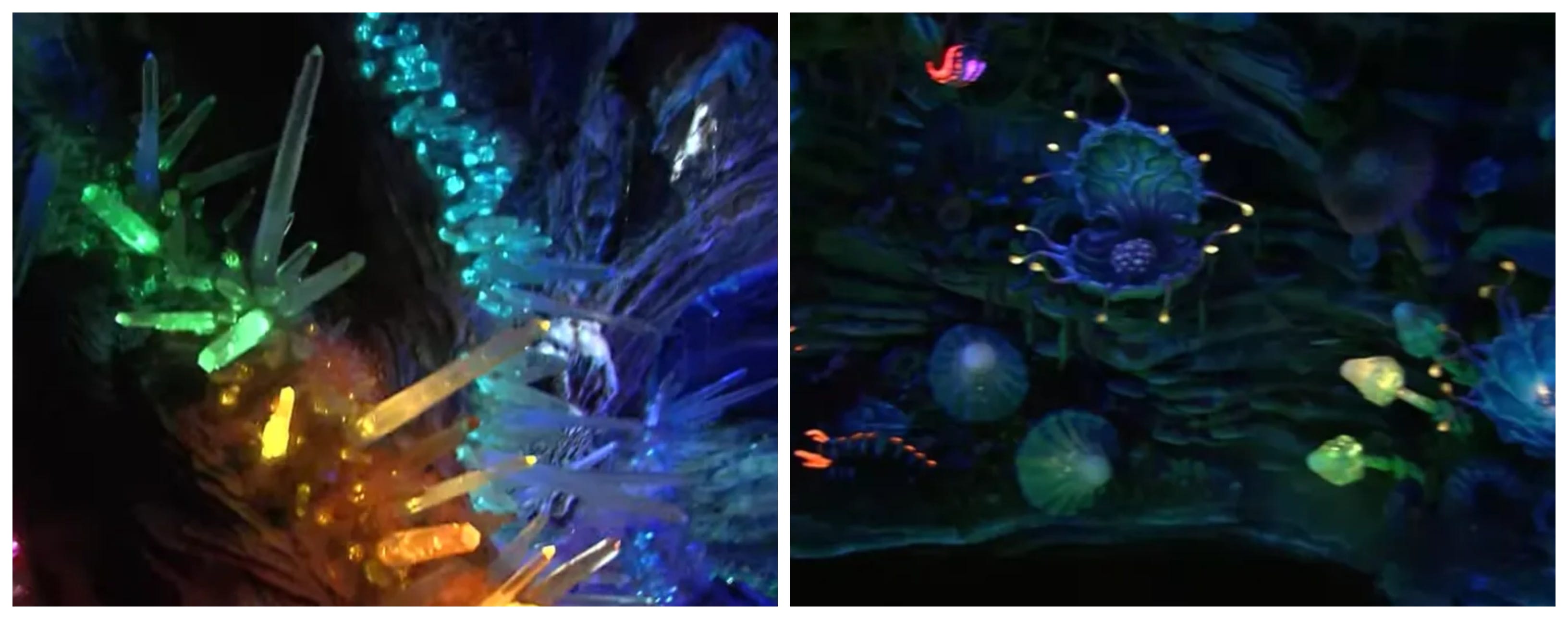
Soon you’re surrounded by dazzling gems. Then you enter a spectacular mushroom forest — supplemented by otherworldly life forms.
And regarding the mechanics of the ride, these effects are absolutely astounding. But part of what makes this all feel so extraordinary is that you are literally heading deeper into the earth, in a grand downward spiral.
Still the tension builds. Sure enough, an earthquake hits, wracking your vehicle. Flames burst up around you. The way ahead is blocked by lava, so you have no choice but to divert into some undiscovered, newly opened chasm.
Now the landscape is truly otherworldly, with even more alien life forms. Lightning flashes in electrified gas clouds on the darkened shore of what looks like a massive subterranean sea. And what’s this? Are those the living egg sacks of that aforementioned massive arthropod?
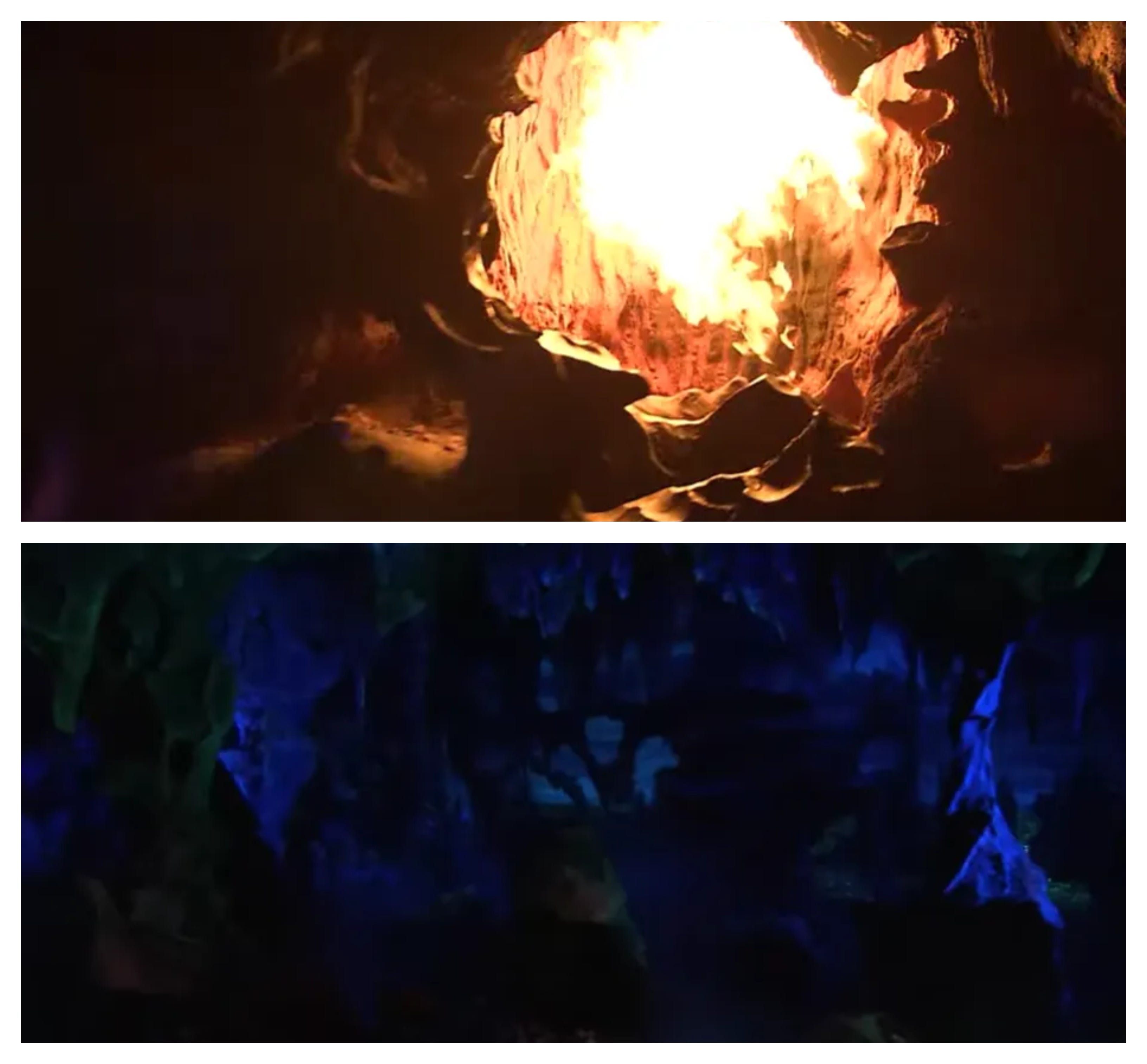
And then? The creature finally appears — a massive centipede-like creature that seems to live inside the lava. It looms above you, screeching horribly.
Is this the end? Are you doomed?
This is the end of Act Two — and as in all good stories, this is the place where the protagonist’s fortunes seem to be at the absolute lowest. The choice is either rise to meet the occasion and somehow become someone better and stronger or to succumb to these opposing forces and fail in the quest.
But all hope is not lost! The earthquake has opened even more fissures in the earth, allowing you to evade the creature at the last second — although it also means entering the lava tube of the volcano itself...
…and lava suddenly propels you up that tube, ever higher and ever faster.
Finally, you burst out of the flaming crater of the active volcano that looms over Mysterious Island. Then you rapidly circle the entire caldera and return to safety.
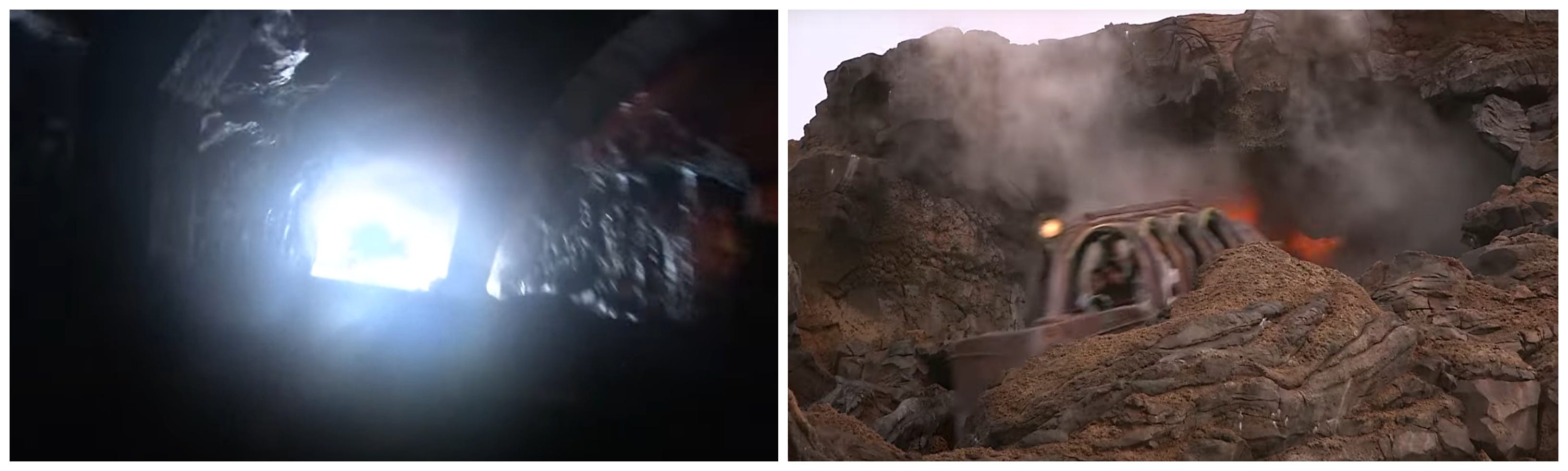
Yes, this is an amusement park ride, so the protagonist — you — don’t make any actual choices. You’re a fairly passive participant.
Then again, the reader of a book or the viewer of a movie is passive too: it’s the protagonist who makes the crucial choices, which the audience witnesses.
And in fairness to the ride, when you’re reading a book or watching a movie, you don’t literally experience anything. Here you do. Imagination is not required.
(My one quibble with the ride is that you disembark your mining vehicle in the same area where you first climbed aboard — which, technically, is deep in the bowels of the earth. But then you immediately exit back out into Mysterious Island, which betrays the parameters of their own established world. But creating a completely separate unloading area to satisfy nitpickers like me is probably an unrealistic expectation, so this is a very small quibble.)
The greater point is, once you open your mind to a broader definition of “story,” you start to see them all around you, even in unusual and surprising places.
Sometimes the tellers of these unorthodox stories aren’t even aware they are telling a story — so these particular stories usually end up fairly or very disappointing.
But sometimes they’re very aware, as the creators of Journey to the Center of the Earth obviously were.
And the results can be absolutely extraordinary.
Brent Hartinger is a screenwriter and author. Check out my other newsletter about my travels at BrentAndMichaelAreGoingPlaces.com. And order my latest book, below.

Brent — this made me smile the whole way through. I love the idea that story isn’t just something we consume, it’s something we’re moved through — sometimes literally.
What really landed for me is your point about the downward spiral and the slow, deliberate build. That sense of descent, foreshadowing, and inevitability is exactly what so many experiences skip now in favor of instant payoff. The patience here is the magic.
Also, your Act Two framing is spot-on. That moment where everything feels blocked and worse before it gets better is such a deeply human narrative instinct — and the fact that a theme park ride pulls it off better than most movies is quietly hilarious.
You’ve officially made me want to go to Tokyo just for this ride. Which, honestly, is a testament to your larger point: a good story really does make everything better.
– Kelly
What an amazing sounding ride! So glad the creators got the story telling right. It's true how that makes all the difference