

Last month, the New York Times published a list of the Thirty Greatest Living American Songwriters.
As with all these lists, it was very controversial — in part because they left off artists like Randy Newman, Billy Joel, Stevie Nicks, Don Henley, and James Taylor.
Then the newspaper released a video of some of the judges discussing their decisions, and things got really ugly.
One core complaint: the songs of the chosen songwriters are often inaccessible, and some very obvious names were overlooked because their work is too commercial.

Regular readers will correctly predict that I side with the online critics of this list and its judges.
I’ve long divided art into two categories: “dessert” and “broccoli.”
Art that is “dessert” can be light or heavy, and it’s not very nutritious, but it’s generally fun and easy to engage with, the kind of thing you’re eager to consume — like actual dessert.
Art that is “broccoli,” meanwhile, is harder to engage with, but it’s better for you — the kind of thing you know you should consume — like, well, broccoli.
When it comes to books and movies — the kind of art that I create — “dessert” projects tend to be the bestsellers and crowd-pleasers. Often, they’re openly romantic or sentimental.
And “broccoli” ones are usually the critical darlings and award winners. These projects might be about “difficult” or “quiet” subjects.
To be clear, there are perils to both kinds of projects. Too often, the dessert projects are mindless and derivative. And broccoli projects tend to be pretentious and also derivative.
You might be thinking: But it’s art! It’s all subjective anyway. And, sure, this is just my opinion.
But I don’t think it’s entirely subjective.
In addition to writing books and movies, I’m also a playwright, and I’ve been to hundreds of performances of my own plays and those by others too.

In the theater, you learn pretty quickly that the audience is usually right. I think their sense of things is at least as good as the critics, and probably a bit better.
When something works on stage, most people in the audience generally agree that it does — and you can absolutely feel it in the air.
When it doesn’t, they don’t — and you can feel that in the air too.
But here’s the real lesson of the theater: the best plays — the ones that audiences really go wild for — are almost always both dessert and broccoli.
I think this is true for books and movies too, but you can’t always feel it in the air, so it’s not quite as obvious.
Audiences want to be entertained — understandably. If it’s a play, they had to go all the way to the theater, and they probably dressed up too. So they don’t want to be bored. They’re hoping to laugh or cry — or both.
But they also don’t want to have to work too hard. It’s been a long day, okay?
In other words, audiences want dessert.
At the same time, most audiences also want to see something they’ve never seen before. They want to be surprised and stimulated. And if the writer has earned their trust, they may also want to be challenged.
In other words, they also want broccoli — assuming it’s a reasonably modest portion, and it’s well prepared. Almost no one likes a self-indulgent writer who is too lazy or untalented to clearly communicate their vision.
Good writing is both dessert and broccoli.
A project that is obviously well-intentioned and about an “important” topic, but ultimately boring or confused or preachy?
That’s bad writing.
At the same time, if a project has nothing new or interesting to say — if it’s nothing but cheap sentiment?
That’s bad writing too.
I know it’s considered bad form these days to criticize anyone’s choices in entertainment, but hey, I think what I think. The whole point of art is to engage the audience.

Including an element of dessert in your writing doesn’t mean dumbing it down, or selling out, or toning down your message. It simply means respecting your audience — acknowledging that their patience is not infinite.
And including an element of broccoli also means you’re respecting your audience — taking for granted that they want works of truth and substance.
What does this mean in the real world?
Well, when it comes to music, it means that it really was ridiculous for that New York Times “best songwriters” list to exclude artists like Randy Newman, Billy Joel, Stevie Nicks, Don Henley, and James Taylor — all of whom I think create music that is almost perfect in its balance of dessert and broccoli.
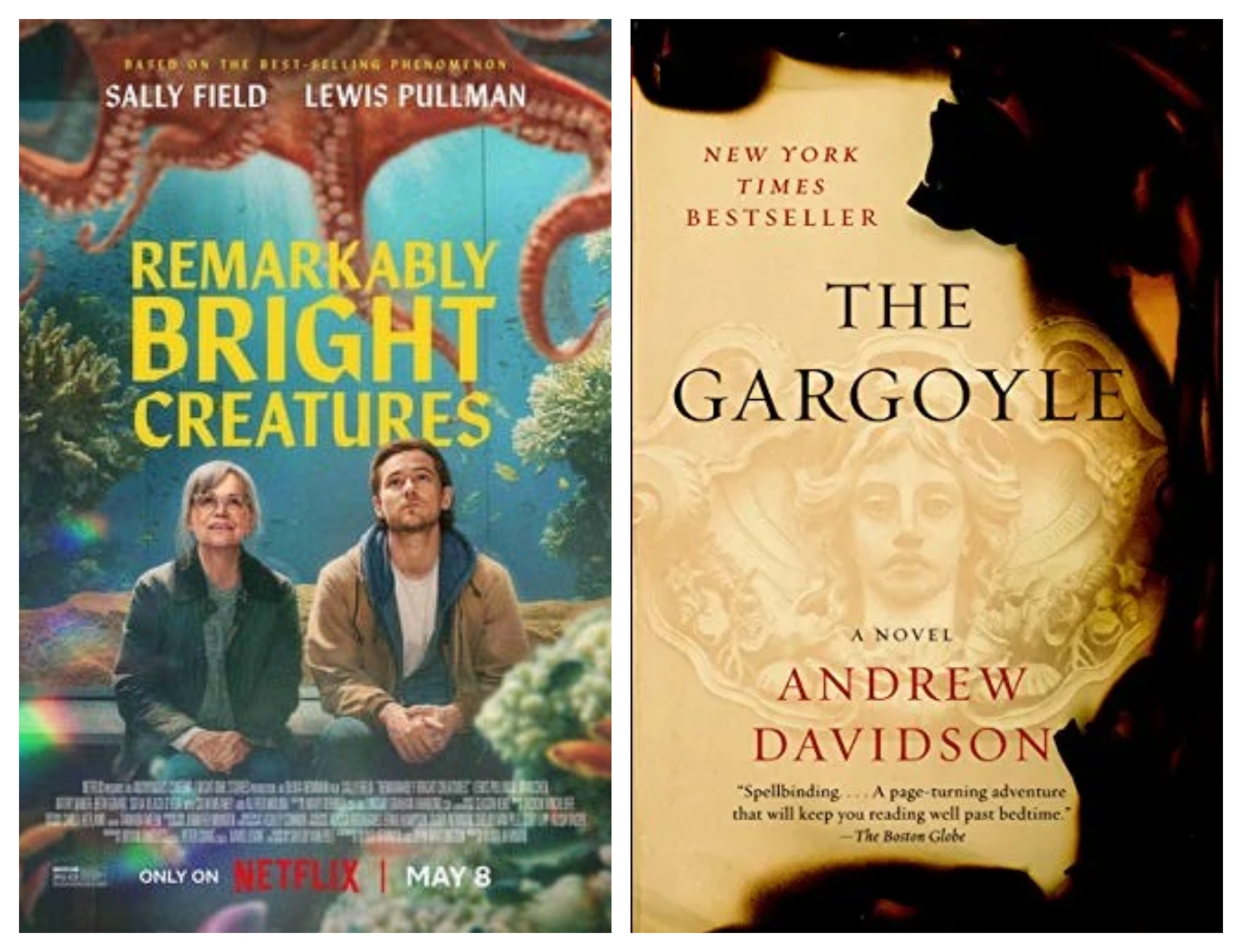
When it comes to movies, I think an excellent example of a project that perfectly balances the two is Remarkably Bright Creatures, now on Netflix, about the relationship between a lonely old woman, an aimless young drifter, and the arrogant octopus at the local aquarium who narrates the story.
There are so many ways this project could have gone wrong — ways it could have become either a grim mess (too much broccoli) or a treacly disaster (too much dessert).
Instead, it’s an almost pitch-perfect film that balances sophisticated themes, prickly characters, an engaging story, and a satisfying yet unexpected resolution.
When it comes to books, The Gargoyle by Andrew Davidson is a 2008 novel about a disaffected porn star who suffers a terrible accident that leaves him with massive burns and searing pain, prompting him to plot his suicide on the day he’s released from the hospital.
Sounds like broccoli, right?
But while still in the hospital, the character is visited by an enigmatic woman who regales him with sweeping stories of what may or may not be their past lives together, and the novel becomes an epic tale of regret, hope, despair, and love, all fueled by the insanely creative imagination of the author.
In other words: plenty of dessert.
There aren’t a lot of rules in writing fiction — and I’m sure there are plenty of people who would disagree with the one I’ve spelled out here.
And even I can already think of one or two exceptions to my “rule.”
But I still think there’s something to this dessert-broccoli combo, and we’d all be better off if more writers took it more seriously.
Brent Hartinger is a screenwriter and author. Check out my other newsletter about my travels at BrentAndMichaelAreGoingPlaces.com. And order my latest book below.

Brilliantly sums up the attitude I’ve noticed towards writers eg Terry Pratchett ‘dessert’ because it’s ‘fun but not serious’ while eg Ian McEwan is ‘hard-going but worthwhile’ broccoli
Loved this analogy! There are times when I enjoy pure dessert or pure broccoli content, but I agree that most of the time, a mix of both produces the most enjoyment and satisfaction.