

I’m a writer, so I’ve spent most of my life in artists’ circles, but can I make a confession?
I’m seriously tired of other artists trying to guilt me into supporting their work.
Look, I get it. It’s really, really hard to make a living as an artist, and “guilt” can seem like a good marketing angle.
Problem is, it’s ineffective. It might work on a very limited basis in the short term, but it’s also manipulative and creates resentment.

In other words, even if it wasn’t “wrong,” this tactic will still hurt your career in the long run.
Here are some of the guilt-related reasons people give for why you should buy their book or painting, or go to their show or movie — and also why they’re so annoying:
“Artists need support!”
On one hand, artists do need support. The life of an artist is a rough one — and in an era of AI and social media “content,” it’s getting even harder.
If we want to somehow keep the arts alive, we all have a responsibility to support them.
But saying “People need to support the arts” is very different from an individual artist saying, “You need to support my art!”
This person isn’t really asking for you to support “the arts” — they’re asking for you to support them.
And that’s self-serving and, frankly, duplicitous.
“You need to support this Really Important Cause!”
Another marketing game many artists play is tying their project to a greater political cause. It might be because the theme of their project involves this cause, or because it’s something about their identity as an artist.
But this is marketing, not actual activism.

I sometimes write LGBTQ-themed YA books, so I get pitched a lot of similar projects, and I’ve lost count of how often I’ve heard writers claim that buying their book about LGBTQ teens will “save lives.”
If I don’t buy their book, gay teens will die? Wow, that’s quite an important book!
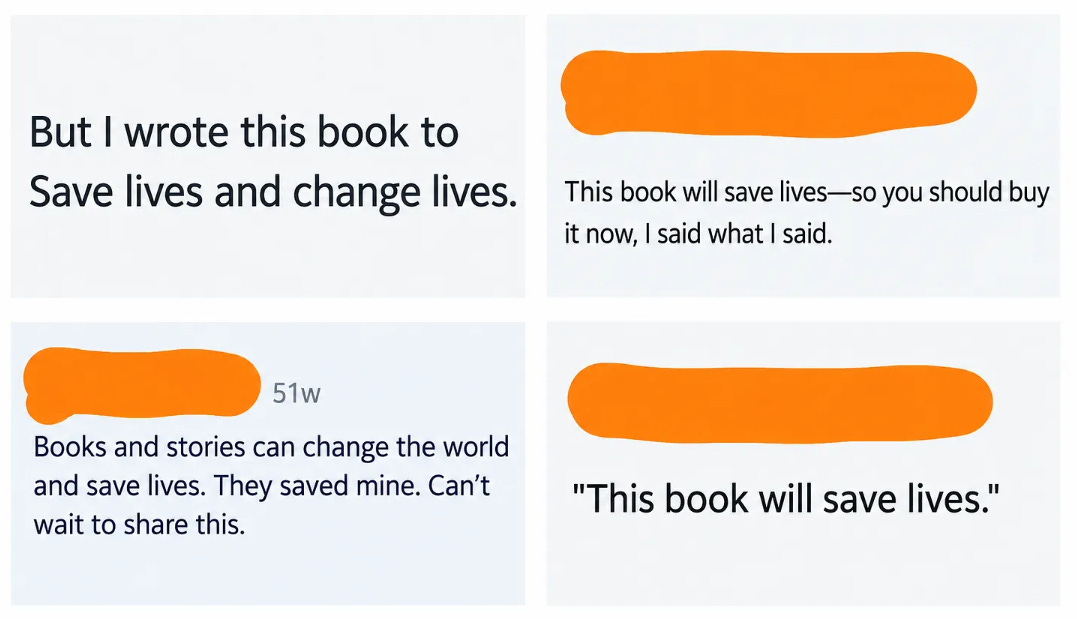
Look, these are real issues: most of these causes are important, and marginalized artists do sometimes need extra support.
But an art project is still just an art project, and it’s unseemly and manipulative to try to seize the general goodwill around some greater issue or concern and use it as a personal marketing angle.
If there’s a legitimate “good cause” claim to be made about your projects, others will make it on your behalf. It’ll be much more effective that way.
“You’re my friend.”
To be fair, there is one genuine guilt-related reason to support someone’s art: friends should support each other.
I love attending plays by friends, and reading their books, and listening to their music. At its best, I feel like I gain real insight into why these people became my friends in the first place.
And once we’re at the “public release” stage, I try hard to be as generous as possible in my praise — and I’m thrilled when my friends do the same for me.

I think it’s okay to ask friends to support your work because they’re your friends — at least if they’re your actual friends, not social media ones, and also not people who you haven’t reached out to in three years.
That said, this should be an occasional ask, especially if these are non-artist friends. And your expectations should be reasonable. No one ever needs to buy a $5,000 painting. In fact, I’d say $50 per couple per year is pretty much a hard limit.
And, of course, this is the kind of thing real friends should do without being asked.
So how should artists market their work? And how should patrons decide which projects to support?
So if I don’t think artists should use “guilt” to market their projects, how should we do it?
It’s not hard: try to capture the imagination of your audience. Tell them why your project is transformative, or imaginative, or simply entertaining.
Don’t go negative — go positive.
Likewise, how should patrons decide which projects to support?
Support the projects you want to support — the books and shows you love, and the authors and musicians who have given you pleasure.
This is how you get people to support the arts: by inspiring their passions and enthusiasm, and touching their souls!
Not by playing on their guilt.
See also…
The Time of the Elves is Over. And by “Elves,” I Mean “Writers of Fiction.”
How Much Should an Artist Care About “the Market” — Or Even the Audience?
As a Writer, You Can’t Please Everyone. Also, You Shouldn’t Even Try.
“Never Give Up Your Dreams” is Terrible Advice
Brent Hartinger is a screenwriter and author. Check out my other newsletter about my travels at BrentAndMichaelAreGoingPlaces.com. And order my latest book, below.
